NerveSense
A scalpel-mounted electrode and amplifier chain that estimates distance to a peripheral nerve from its stimulated response.
Overview
A group project at NEU London aimed at giving a surgeon a proximity readout for peripheral nerves during incision, rather than only detecting contact once it has happened.
A TENS unit stimulates the tissue and an electrode mounted on the scalpel picks up the nerve's electrical response. The signal passes through an instrumentation amplifier and bandpass filter, then into a Raspberry Pi Pico, which maps amplitude to distance using an exponential fit and drives an LCD readout. Against the test setup, the fit gave R² = 0.93 and resolved distances out to about 5 cm with roughly ±0.5 cm spread.
My work was on the analog front end and the physical build: the amplifier board, the electrode design, and the CAD for the housing and scalpel probe assembly.
How it works
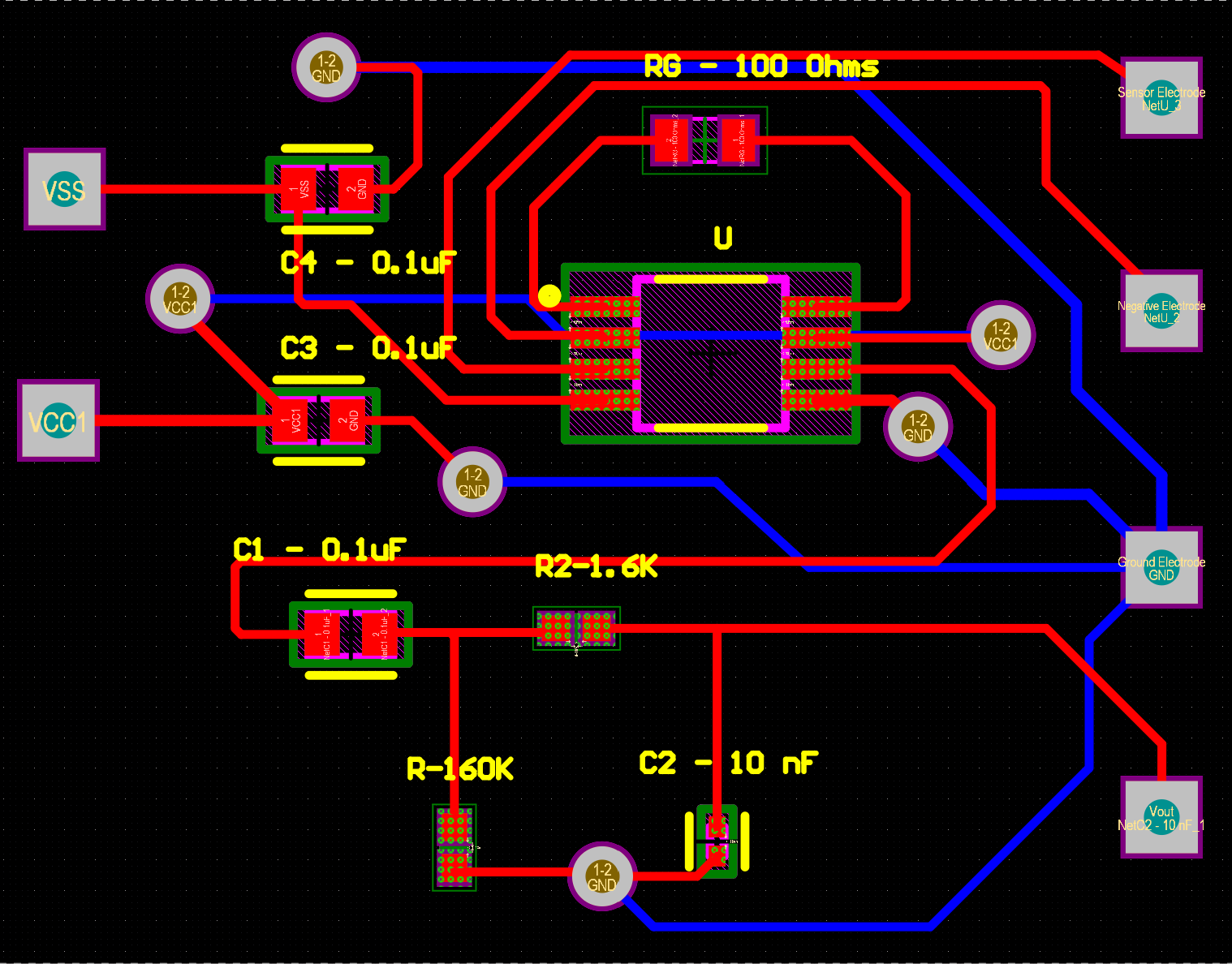
- Custom PCB designed in Altium with an INA333 biomedical amplifier and bandpass filter
- AD620 amplifier module (100× gain) for signal amplification
- Raspberry Pi Pico reads the ADC and applies an exponential amplitude-to-distance fit (R² = 0.93)
- 20×4 I2C LCD proximity readout, resolving to about 5 cm at roughly ±0.5 cm
- AgCl-coated silver electrodes to minimize capacitive interference
- CAD-designed 3D-printed enclosure and scalpel probe assembly